
NOAA Forecasts Hot and Sunny Summer
The weather forecast for this summer on Long Beach Island, NJ calls for plenty of sunscreen and strong warnings about rip currents. Coastal Living LBI sat down with Jon Gottschalck, the Chief of the Operational Prediction Branch for NOAA’s Climate Prediction Center and had him tell us why,

Q. Can you tell us what we are looking at weather-wise for Long Beach Island NJ this summer?
A. Basically from a climate perspective we see overall above normal temps from the second half of the spring into the summer. In other words, odds are sunny and hot are in the forecast for you guys this summer.
Q. Is your forecast for hot and sunny summer weather a possible scenario – or a definite one?
A. I can assure you that when it comes to the weather there are never any definite scenarios. We are talking about probability or odds. There’s a lot of potential for forecast changes. But our forecasts do have above normal accuracy, especially with dry conditions.
Again, what we are seeing for your area this summer is hot and sunny. Above normal temperatures with lower-than-normal precipitation. We are not seeing any clear signal for a wet summer. On average.
We are favoring El Nino development. This could be important to a barrier island like you. Rip currents are directly affected by El Nino, and this is of concern to you even if storms are hundreds of miles away. Last summer was horrible for rip currents. I had a good friend in North Carolina who got caught in a rip current and died last summer. It’s real and let me stress that when it comes to rip currents you do not want to take a chance.
Q. Is forecasting the weather tricky business?
A. Yes. For what we do here, it’s important to recognize we do short term climate prediction. We don’t do climate change at all. Bottom line, we try to determine whether things will be drier, or colder, warmer or wetter than normal. Average conditions are what we look at and it’s very tricky.
Q. How do you produce your weather forecasts and what methods or tools do you use to ensure they are accurate?
A. One of the tools we use to try for accuracy includes looking at ongoing weather conditions. Drought or very wet conditions in other areas of the country, for example, can all have an impact on us here.
It is important to realize that weather doesn’t happen in a bubble. What happens elsewhere influences what you go through now.
We also rely on short-term computer models that simulate weather conditions to predict short-term climate forecasts. Have these models been consistent for a few months or are they all over the place? We mix these together with our own expertise to come up with a forecast.
Q. How do oceans influence the weather – especially the Atlantic Ocean?
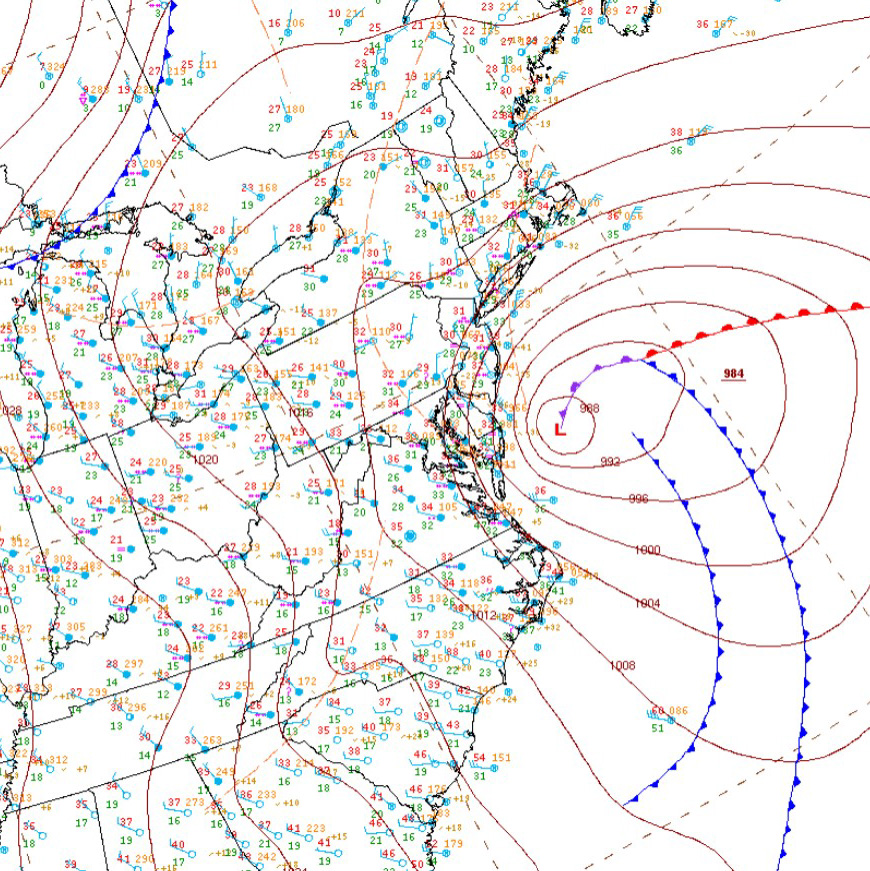
A. Locally your ocean temperatures affect the climate. Water temperatures play a big role with the weather. Warm days can suddenly turn cool. An east wind off the water can change a day that was supposed to be in the 70s into one in the 40s. In the summer It can be warmer off the island when land temps heat up, but back door cold fronts coming off the ocean in the summer cool things off. Temps on the island may be high, but when the ocean is cooler, temps are cooler. Warmer water makes temps warmer too. The temperatures of your ocean really impact the weather on Long Beach Island.
Q. As one of the top beach communities in New Jersey, LBI’s year-round population, on average, is approximately 20,000 residents. During the busy summer months, the population swells to almost 200,000. Can an increase of people on LBI and their behaviors affect the weather?
A. Yes absolutely. One of the biggest ways human behaviors influence the weather – and this is not debatable at all -is something called the urban heat island effect (UHI) where temperatures are higher in urban areas as compared to rural areas. Dark colored roadways and building materials, more buildings, high buildings all restrict air movement and absorb heat. On Long Beach Island, less grass and more gravel mean less natural cooling and more heat. It builds up overnight and stays that way the next day.
More people on the island means more energy consumption, more traffic and more heat. The more human behavior causes things to get hot, the more a human being’s temperature goes up. People get edgy when temperatures are hot. Road rage is a very real thing.
Q. As the Chief of NOAA’s Climate Prediction Center what does a typical workday look like for you?
A. For me, there is a difference between my mornings and afternoons. Mornings I’m responsible for making sure everything we do is completed on time and that our weather forecasters have all the tech tools they need. My afternoons are devoted to meetings and policy decisions. We do presentations and talk to the USDA, FEMA, the Army Corps of Engineers, the Department of Defense, and the media like what we are doing today. We do this every day. We feel we are essential. Even during the government shut down we went for 6 weeks not getting paid. Obviously, we like what we do.
Q, Any misconceptions people may have about your job?
A. There’s a certain degree of people who think we’re like the Farmer’s Almanac. I’m not trying to downplay what the Farmer’s Almanac does, but some people don’t realize what goes into weather forecasting. It’s not exact science but we do take our jobs very seriously. We are professionals with graduate level degrees, and we have a lot of expertise. We do probabilities, the chances about something happening. Our outlooks are probabilistic. That’s important to know.
Q. Have you ever had any of your weather predictions go completely wrong?
A. It happens. The weather doesn’t march to our forecast. We do try to minimize that. But even when something goes wrong there is value added because we can get data from that. We always have a probability that we will be wrong. For a forecast to be reliable we need to be right about 70 percent of the time on average. But to be right we need to be wrong sometimes too. If anyone tells you they haven’t been wrong, a weatherman or a forecaster, they are lying
Q. Do you have any suggestions for all of us this summer on Long Beach Island, NJ?
A. Oh yes.
First, even if there isn’t a threat of hurricane, you should always be prepared. Stock up on the normal things like extra batteries, test your generator, those types of things. You should always be prepared, because with hurricanes it only takes for one to happen.
But the one thing that really, really worries me the most for this summer is rip currents. The media needs to put the word out about this before the season starts. Whether there’s a flag or a sign that says don’t go in the water, please, please heed it. Swells and rough surf are unpredictable especially on your island. We lose people every year, but it is preventable.
For more weather information go to noaa.gov.