
Memories Made to Last
The next time you sit down on a memorial bench on Long Beach Island, NJ listen closely.
Each one has a story to tell you.
That story is something Laura Dunlap hopes to uncover as she documents LBI’s memorial benches and the lives they honor with her project Behind the Benches LBI.
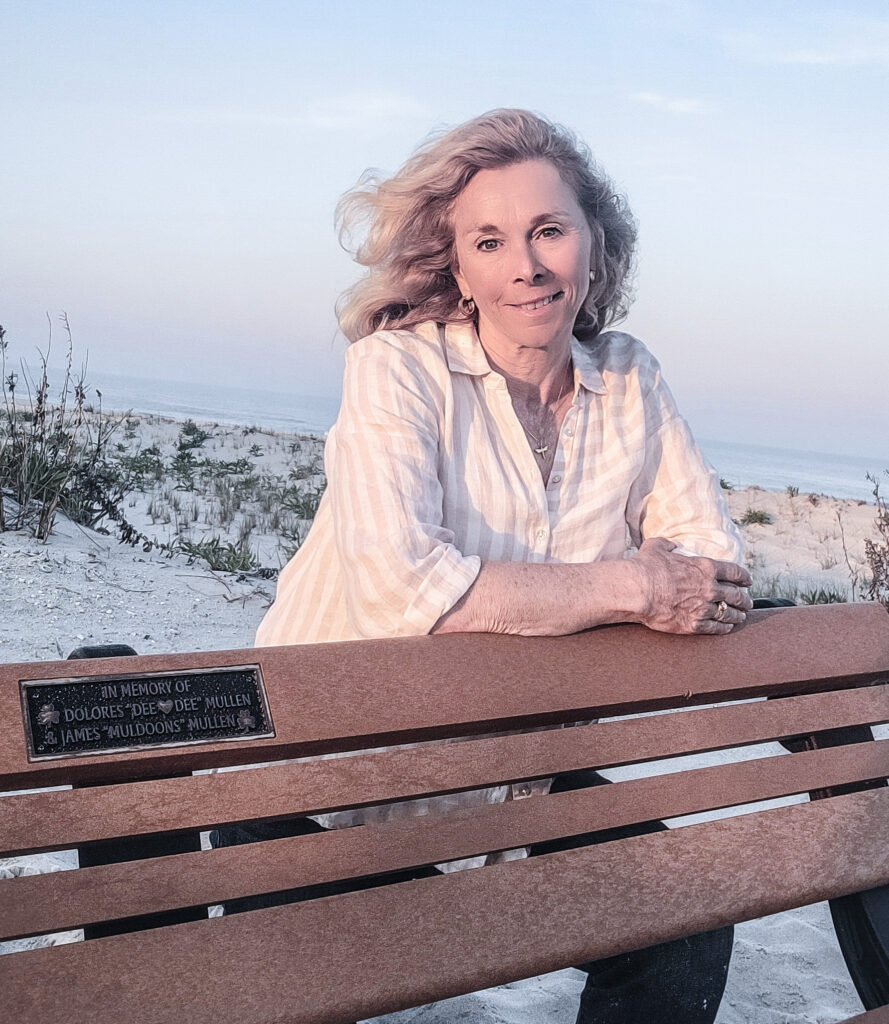
These stories are contained in one or two, maybe three lines engraved on personalized plaques attached to the benches you’ll find scattered on the beach. The benches and plaques are purchased from municipalities on Long Beach Island and come with a ten-year, renewable lease.
“Every town is different,” Dunlap said. “And a lot of them are not offering the benches anymore. They offer bricks but not benches.”
Dunlap’s passion for reading and decoding the plaques began during a time she was dealing with her own personal grief and loss.
“It was during the pandemic,” Dunlap said. “It was a difficult time for me. I’d just lost my mom, a family pet, and my younger son was leaving home. I would walk my dogs, what else could you do? I started viewing the benches and wondering what each plaque meant.”
Dunlap began to realize the plaques she was reading meant more than just remembrance. “They are stories about someone’s life,” she said. “Universal messages that have to do with love, loss, and laughter.”
To find out more about the person memorialized on the plaque, Dunlap knew she’d have to talk to the person responsible for purchasing and designing it.
“I thought doing the research would be easy,” Dunlap said. “But it wasn’t as easy as I thought.”
She began her research by filing an open request with each township and borough. Open request refers to a formal request asking for access to public records. In New Jersey the Open Public Records Act (OPRA) allows individuals to request documents from government agencies. It involves filing out a form and providing details about the records being sought.
“I got a list of all the benches on Long Beach Island,” Dunlap said. “Each town keeps a list a different way. Sometimes they don’t have any records. It depends on how they process them. Some records have the name of the person who purchased the bench but nothing else.”
A single name on a plaque once gave Dunlap the information she needed to track down the story.
“There’s a bench on Holyoake Avenue in Beach Haven and it says, ‘May all your weeds be wildflowers’ which I just loved,” she said. “I look at the name on the plaque, and I realize I know that person’s sister and I was able to reach out to her for the story.”
Dunlap’s next step involved posting a notice on a community Facebook page called All Things LBI.
“These stories are very meaningful. They are about someone’s life, someone’s loss, their legacy. These are deep personal memories. For many, talking about the bench means revisiting love, loss, family, grief, and the life of someone they still miss. There is a lot of emotion in this work. And I think that is why it matters.”
-Laura Dunlap
“Several people reached out as a result of that post,” she said. “Some wanted to share the stories behind benches placed for people they loved. So far, I have completed four interviews with the people who reached out. I have already published one story about the Hurley family, I am about to publish another, and there are two more I am currently completing.”
Dunlap said people have been very willing to talk to her when she interviews them. And when she does talk to someone, she is very careful to let them take the lead.
“It’s their story and I want it to be in their voice not mine.” she said. “These stories are very meaningful. They are about someone’s life, someone’s loss, their legacy. These are deep personal memories. For many, talking about the bench means revisiting love, loss, family, grief, and the life of someone they still miss. There is a lot of emotion in this work. And I think that is why it matters.”
Loss and connection are the two threads Dunlap sees woven through every conversation.
“People talk about how they are moving through their loss and then they talk about the connection their loved ones had to Long Beach Island,” she said. “I interviewed two brothers whose father passed away during the pandemic, and they couldn’t have a funeral. They got the bench so that one day the family would have some place to get together.”
One interview in particular has stayed with Dunlap.
“It’s a story that is sad but also inspiring,” she said. “A young woman was diagnosed with cancer at 26. I interviewed her mom. Her daughter really fought cancer for 10 years but during that time she accomplished a lot. In the span of 10 years, she continued to work as a teacher. She got married, bought a house here on the island.”
So far, all the memorial plaques Dunlap has researched have been for people who have passed away. “I haven’t come across anyone who just puts up a plaque for themselves,” she said. “Some benches have two plaques. One for the husband and one for the wife. I have seen pets. I found one for a child.”
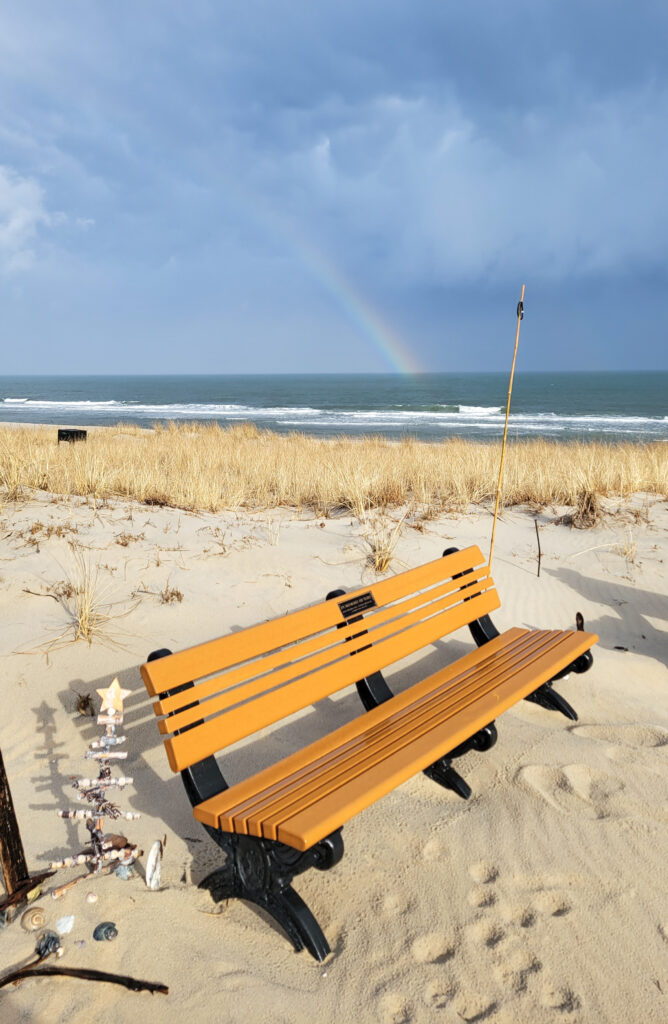
Dunlap noted that for some, memorial benches are more than just places to sit. They are also spots people use to visit and reflect.
“These benches are places where people can go and just feel better,” she said. “One woman told me she goes to visit her husband at the cemetery but it’s not the same thing as coming to visit him at the beach. On the beach there’s life, people are goofing around having fun. When people sit next to you on the bench, maybe you don’t know them, but you talk to them anyway and they talk to you.”
Dunlap always likes to ask the people she interviews why they picked the spot they did for their bench.
“The answer usually has to do with the memory that’s attached to it,” she said. “One man told me this was the place where his mother always came to the beach.”
All of Dunlap’s stories about Long Beach Island’s memorial benches can be found on her blog on substack. She also has plans for a book, tentatively titled Behind the Benches LBI.
“I’d like the book to remind people that the plaques they pass by and read every day are markers of life, not just of loss,” she said. “The names on these plaques represent people who have affected the lives of others, not always in big ways but in ways that are meaningful.”
As far as her own plaque is concerned Dunlap isn’t sure what she would like it to say.
“Interesting question,” she said. “Maybe something to the effect that our lives are not about ourselves but about the lives of others that we touch.”
Images Supplied by Laura Dunlap
Contact Information
Email: be*****************@***il.com
Substack: behindthebencheslbi.substack.com/
Instagram: @behindthebenchlbi
Facebook: behindthebencheslbi